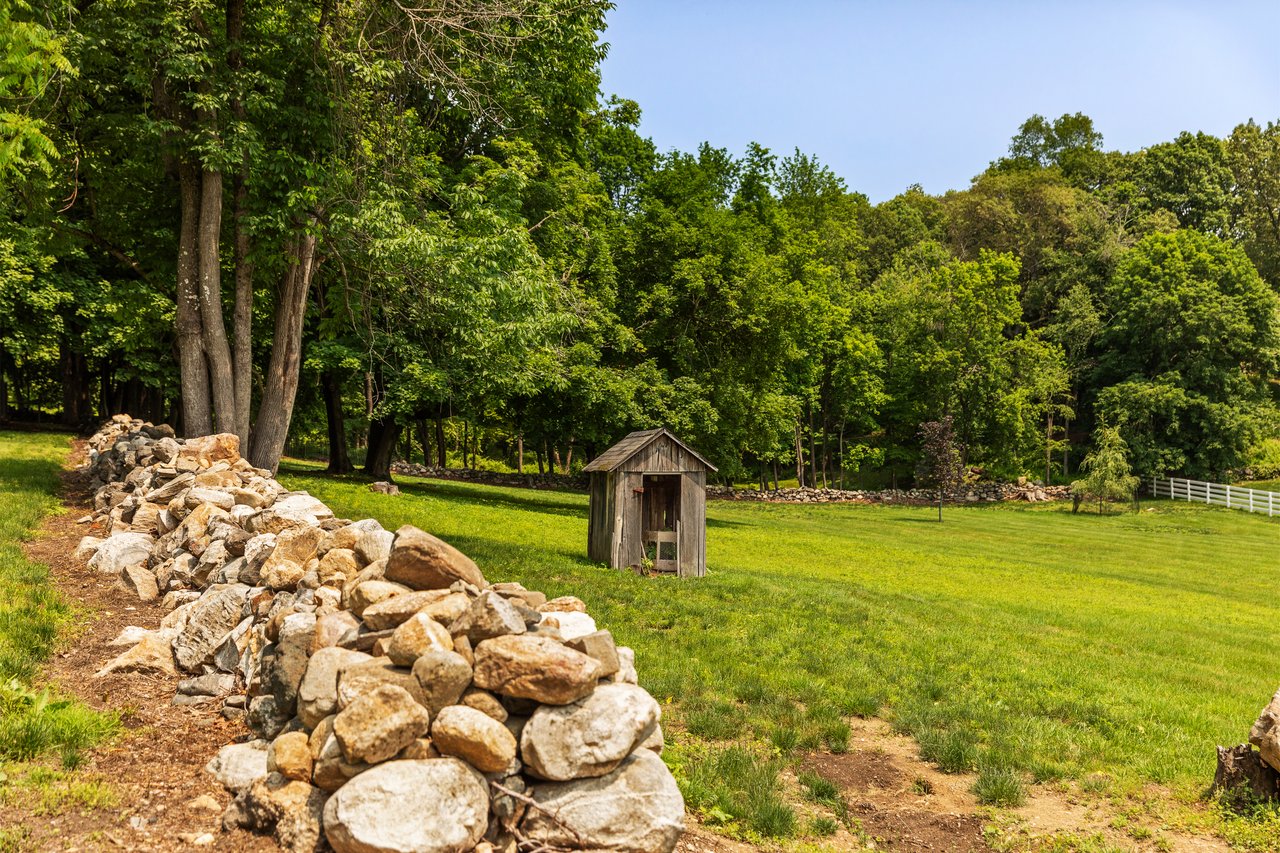
Welcome to Katonah
Katonah is a hamlet of the Town of Bedford in northern Westchester County, built on its present site in the 1890s after New York City's water supply work condemned the old one. It is a hamlet, not a village government, and most of what a buyer or seller needs to know follows from that: one town hall, one zoning code, a locally designated historic district around the Katonah Greens, a Harlem Line station with Town parking rules, and a mix of public water, sewer, wells, and septic depending on the street. On this page, The Garay Team sets out what the public record says about Katonah and what it means for someone buying, renovating, building, or selling here.
A hamlet inside the Town of Bedford
Katonah is an unincorporated hamlet in the Town of Bedford. The Town Supervisor's welcome letter states that the Town of Bedford contains three unincorporated hamlets, Bedford Hills, Bedford Village, and Katonah, as well as areas outside the hamlet ZIP codes sometimes called Bedford Corners. Each hamlet has its own library and its own volunteer fire department. Source: Town of Bedford, Letter from the Supervisor.
- One local government. Zoning, building permits, assessment, town taxes, and parking permits for a Katonah parcel all run through the Town of Bedford. There is no separate Katonah village board or village code.
- Town figures. The Town's About page says Bedford was founded in 1680 and spans 39.3 square miles. Those are figures for the whole town, not for Katonah alone. Source: About the Town.
- The name on the mail. Katonah addresses use ZIP 10536. A Katonah mailing address is not proof of the town, school district, or zoning district for a parcel. Confirm all three on the tax map and the deed.
Our Bedford guide covers the town as a whole and its other two hamlets, Bedford Village and Bedford Hills.
The hamlet that moved: the 1890s relocation
Present-day Katonah is not where Katonah started. The Westchester County Archives summarizes the story this way: New York City began planning the New Croton Dam and an enlarged Croton Reservoir in the 1880s, Katonah lay in the path of those plans, its properties were condemned and the owners compensated, and the buildings were auctioned off. Rather than abandon their community, residents bought back many of their buildings and moved them to higher ground. The County's record includes an Old Katonah taking map dated August 10, 1896, an auction broadside, and photographs of houses jacked up and moved along tracks. Source: Westchester County Archives, Relocation of Katonah.
- Before the move. The Town timeline records that the earliest inhabitants of what would become Katonah appeared along present-day Cherry Street in 1705, that a mill on the Cross River in 1812 started a hamlet called Whitlockville, and that the New York and Harlem Railroad reached northern Westchester in 1847 with a Whitlockville Station. In 1856 the post office moved to the station and the growing hamlet was renamed Katonah.
- The condemnation. The timeline records an April 1893 New York Times headline, "Destruction to Katonah," reporting that the new dam would result in the condemnation of both Katonah and Whitlockville.
- The move itself. Between 1896 and 1905, using horses and capstans to pull them along log tracks, residents moved about fifty-five homes, businesses, and churches to the new Katonah site.
- April 5, 1897. The timeline calls this new Katonah's birthday: the train bypassed the old station for the first time and stopped at the new site, and mail was distributed there from that day on.
- 1906 to 1907. New York City reservoirs began to fill.
Source: Town of Bedford, History of Bedford with Timeline.
The Katonah Village Library's history adds that the dam location was settled in 1891 and that residents formed a syndicate to plan the new site and keep the community together. Source: Katonah Village Library, Our History.
The reservoirs today. New York City's Department of Environmental Protection describes the Muscoot Reservoir as lying just north of Katonah, placed into service in 1905, and joined to the New Croton Reservoir; the old Muscoot Dam near Katonah is now submerged and the two reservoirs form one long lake. Sources: NYC DEP, Muscoot Reservoir and NYC DEP, New Croton Reservoir.
The Katonah Village Historic District and the Katonah Greens
National Register. The National Park Service record for the Katonah Village Historic District (reference 83001830) is dated September 15, 1983. It lists the location as Parkway, Valleyedge, Edgemont and Bedford Roads, the styles as Late Victorian and Queen Anne, landscape architecture and architecture as areas of significance, 1895 and 1928 as significant years, and B. S. and G. S. Olmsted as the designers. Source: NPS NPGallery, Katonah Village Historic District.
Local designation. A National Register listing by itself does not regulate private renovation. What does is Article II of Chapter 71 of the Town Code, the Katonah Historic District Preservation Ordinance, adopted in 1986. Its findings describe the area as a rare surviving example of a turn of the century planned community and "the village that moved," with most buildings either built or moved to their sites between 1895 and 1910, and they declare the Katonah Greens, the grassy medians of the Parkway and Bedford Road, to be scenic landmarks. Its boundaries matched the Register boundaries when adopted. Source: Town Code Ch. 71, Article II, Katonah Historic District.
- What needs review. A certificate of historical review is required before any major change in exterior appearance, and before other Town permits issue. The Code defines a major change to include work that needs a special use permit, use variance, or site plan review; demolition of all or part of a principal or accessory structure; new construction; an enclosed addition; and adding or removing a deck or porch.
- What usually does not. The Town's commission page states that roofs and paint colors are not subject to district commission review.
- Who reviews. The five-member Katonah Historic District Advisory Commission holds a public hearing on each application, with notice to all owners of property in the district, and files a written report within 30 calendar days of a complete application.
- If the Commission objects. The Town Board reviews the report and may direct issuance of a certificate or decide that none should issue, with findings due within 45 days. If neither body acts within the set times, the applicant may proceed as if a certificate had issued.
- Trees count too. The Town's tree law requires a permit to remove any tree within a Town historic district, with limited exceptions; the chapter defines a tree as six inches or more in diameter at breast height. Source: Town Code Ch. 112, Tree Preservation.
Source for the commission: Katonah Historic District Advisory Commission. The district map is posted on the Town's Maps, Plans and Zoning Regulations page.
Historic buildings outside the district
Older houses on Katonah back roads can still be regulated even if they are not on the Greens. Article III of Chapter 71, the Historic Building Preservation Law, applies everywhere in the Town outside the Bedford Village and Katonah historic districts. Buildings on the Town's Survey of Historic Buildings are categorized as Tier 1, Tier 2, or unregulated.
- Tier 1. Alterations beyond as-of-right work (such as paint, roofing, repairs in kind, and interiors), and any demolition, go to the Historic Building Preservation Commission for a public hearing.
- Tier 2. All work is as-of-right except demolition, which needs an administrative permit from the Director of Planning.
- What demolition means here. Destroying, disassembling, replacing, or relocating more than 50 percent of the exterior wall surface or structural frame of a listed building, including over a five-year period.
Source: Town Code Ch. 71, Article III, Historic Building Preservation. Before you plan a teardown or a large addition, ask the Building Department whether the house is on the Survey and in which tier.
Zoning under Chapter 125
Katonah follows the Town of Bedford zoning code, Chapter 125. As amended in September 2025, it divides the town into these districts:
- One-dwelling residence districts: R-4A (four acres), R-2A (two acres), R-1A (one acre), R-1/2A (one-half acre), and R-1/4A (one-quarter acre).
- Two-dwelling and multiple-residence districts: TF, VA, MF, EL, and DH.
- Commercial and industrial districts: RO, PB-O, PB-O(K) (a Planned Business Office district specific to Katonah), PB-R, NB, CB, RB, and LI.
District boundaries are set on the Official Zoning Map, a set of 45 sectional maps dated November 17, 1970, as amended and filed with the Town Clerk; the consolidated zoning map is for general information. Source: Town Code Ch. 125, Article II.
Dimensional limits. The Town's residential dimensional table sets, among other things:
- R-4A: 4 acres minimum, 75-foot front yard, 3 percent building coverage, 8 percent impervious coverage.
- R-2A: 2 acres, 50-foot front yard, 6 percent building, 14 percent impervious.
- R-1A: 40,000 square feet, 35-foot front yard, 10 percent building, 20 percent impervious.
- R-1/2A: 20,000 square feet, 35-foot front yard, 15 percent building, 30 percent impervious.
- R-1/4A: 10,000 square feet, 35-foot front yard, 20 percent building, 40 percent impervious.
- Height: 2 1/2 stories and 35 feet in these districts, and a maximum exposed building elevation of 40 feet in all residential districts.
Source: Table of Dimensional Requirements, Residential (PDF). Impervious coverage includes driveways and patios, so on a smaller lot near the center it can limit a pool, garage, or addition before the building coverage does. Have the numbers run on a current survey before you commit to a plan.
Permits, steep slopes, wetlands, and trees
Building Department. The Town lists permits as required for sheds, additions, demolition, electrical and plumbing work, fences and walls, finished basements, generators, oil tanks, renovations, replacement windows, roofs, pools, and tree removal, among others. Work found built without a permit carries a legalization fee of $1,000 plus the original permit fees ($500 plus fees for an already built shed), and that includes finished basements, decks, and pools. Source: Building Department.
Steep slopes and ridgelines. Chapter 102 defines steep slopes as ground with a slope of 25 percent or more over at least 100 square feet and 10 horizontal feet. Disturbing one, or a mapped ridgeline preservation area, needs a permit. Source: Town Code Ch. 102.
Wetlands. Under Chapter 122, the regulated wetland and watercourse buffer extends 100 feet from the wetland boundary or the bank of a watercourse. The Wetlands Control Commission, in place since 1973, issues full permits for work such as driveways, pools, tennis courts, septic fields, and grading, while lesser work such as sheds, fences, decks, and porches can go through an administrative permit. Sources: Town Code Ch. 122 and Wetlands Control Commission.
Trees. Beyond the historic district rule above, a tree removal permit is needed for any tree 18 inches or more in diameter at breast height, for trees over eight inches within 150 feet of the center line of a designated scenic road, for trees in wetlands or on steep slopes, and for removing more than 10 trees in a calendar year on a property of four acres or less, with higher counts for larger properties. Source: Town Code Ch. 112.
Flood maps. For any house near a stream, a pond, or low ground, check the FEMA map at the FEMA Flood Map Service Center and get insurance quotes early.
Water, sewer, wells, and septic
Utilities in Katonah depend on the street, so check them parcel by parcel.
- Public water. The Town's Water Division runs four districts. The Consolidated Water District distributes water to homes and businesses in the Katonah and Bedford Hills areas, and the Town notes that the remainder of residents rely on private wells that the Town does not operate. Source: Maps (Water Districts).
- Sewer. The Town Code includes a Bedford Hills-Katonah Business Sewer District and a Bedford Hills-Katonah Phase II Sewer District. The Town's Phase II page describes sewer service for 89 residential properties primarily along Bedford, Edgemont, and Valley Roads in Katonah, replacing septic systems and cesspools, with construction that began in November 2023; owners connect and abandon the old system. Source: The Sewer Project, Phase II.
- Everywhere else. Expect a well, a septic system, or both. Ask for well test results, septic pumping and inspection records, and any Health Department approvals, and confirm whether a house on the Phase II streets has already connected and abandoned its septic system.
- The watershed. DEP states that the Muscoot Reservoir's own watershed includes portions of the Town of Bedford. Ask whether any watershed rules, easements, or setbacks affect a specific parcel before you plan new septic work or grading.
Property taxes and assessment
The Town of Bedford Receiver of Taxes collects school taxes for the three school districts that serve Bedford, Bedford's share of the Westchester County tax, and Town and special district taxes.
- School tax: two installments, due September 30 and January 31.
- Town and County tax: one installment, due April 30.
- Buying mid-cycle. If you buy after the September school tax deadline but before January 31, the Town asks new owners to contact the Receiver to confirm what is due. If you pay your own taxes and have not received a bill by April 1 (Town and County) or September 1 (school), contact the office.
Sources: Tax Receiver and New Homeowners.
Assessment calendar. The Town Assessor lists May 1 as taxable status date and the exemption application deadline, June 1 for the tentative assessment roll, a grievance period from June 1 through Grievance Day on the third Tuesday in June, and September 15 for the final roll. Sources: Assessor and Grievance. We do not publish tax rates; ask us for the current bills on any house you are considering.
Katonah station, parking, and getting around
The station. Katonah station is on Metro-North's Harlem Line. The MTA lists it as an accessible station with elevators, tactile warning strips, and audiovisual passenger information, two ticket machines in the overpass, no ticket office, and connections to Bee-Line buses and the Ridgefield-Katonah Shuttle. Check the current timetable; we do not quote travel times. Source: MTA, Katonah station.
Town lots in Katonah. Chapter 117 of the Town Code designates three Katonah lots for permit and restricted parking: Lot 1 at 2 Jay Street, Lot 2 on Katonah Avenue, and Lot 3 at 50 Woods Bridge Road. Unless posted otherwise, restrictions apply on weekdays from 5:00 a.m. to 6:00 p.m., with listed holidays excepted, and parking is open to all without a permit from Friday at 6:00 p.m. through Monday at 5:00 a.m. Nonresident permits are issued only for Lot 3. Source: Town Code Ch. 117, Article III.
The Town's Parking page adds that Lot 1 at the station and Lot 1a on Jay Street carry resident commuter permits plus day passes after 10:00 a.m., that Lot 2 has business permits and hourly parking, and that from November 15 to April 1 there is no on-street parking between 11:00 p.m. and 7:00 a.m. unless marked. Source: Town of Bedford, Parking. If you plan to drive to the train, check permit availability before closing.
Library, museums, Caramoor, and the John Jay Homestead
- Katonah Village Library. At 26 Bedford Road, on a corner lot the planners of the new hamlet set aside for it. The library's history dates the first reading room to 1880 in Old Katonah and the dedication of the present brick and stone building, designed by Kerr Rainsford, to December 5, 1930. The Katonah Historical Museum is on the library's third floor. Source: Our History.
- Katonah Museum of Art. At 134 Jay Street. It began in 1954 as the Katonah Gallery on the library's third floor and became the Katonah Museum of Art in 1990, when it moved to its building on Route 22 at Jay Street. It originates three to four exhibitions a year. Sources: Katonah Museum of Art and the library history and Town timeline above.
- Caramoor. At 149 Girdle Ridge Road with a Katonah address. Caramoor describes its 81-acre property as the legacy of Walter and Lucie Rosen, who established it as a center for music and art in 1945; it offers concerts, Rosen House tours, and gardens. The Town Code lists Caramoor among Bedford's historic places. Source: Caramoor Center for Music and the Arts.
- John Jay Homestead State Historic Site. At 400 Jay Street, Katonah, on 62 acres. John Jay retired to his Bedford farm in 1801, and the Town timeline records New York State acquiring the Homestead in 1959. The site's FAQ says Bedford House is closed for preservation and restoration work, that a full site closure for construction was anticipated in early 2026, and that reopening is expected in late 2027. Check before you go. Sources: NY State Parks and John Jay Homestead FAQs.
- Katonah Memorial Park. One of three Town parks, at the top of North Street, with a pool, tennis, platform tennis, basketball, fields, picnic areas, and a playground; the Town timeline dates its dedication to Memorial Day 1950. The Town has a 2026 project to renovate its playground. Sources: Town Parks and Facilities and Playground Project.
Public schools, stated plainly
The Katonah-Lewisboro Union Free School District lists five schools: John Jay High School, John Jay Middle School, Increase Miller Elementary School, Katonah Elementary School, and Meadow Pond Elementary School. Its district office is at 60 North Salem Road in Cross River, and the federal NCES record lists a Katonah mailing address. Sources: Katonah-Lewisboro School District and NCES district record.
School district lines follow parcels, not hamlet names or ZIP codes, and the Town's Receiver collects for three school districts that serve Bedford. Confirm the district and the elementary assignment for a specific address with the district before you make an offer. We do not rate schools or steer anyone toward or away from any area.
Advice for buyers and sellers
If you are buying:
- Confirm the town, school district, and zoning district for the exact parcel. The 10536 address is not enough.
- Ask whether the house is in the Katonah Historic District or on the Town's Survey of Historic Buildings, and in which tier, before you plan exterior work.
- Run building and impervious coverage on the survey if you want a pool, garage, or addition.
- Confirm public water or well, sewer or septic, and on the Phase II streets whether the house has connected.
- Check wetlands buffers, steep slopes, and trees on any lot you plan to build on.
- Ask for permits and certificates for past work, especially finished basements, decks, pools, and generators.
- Read the current tax bills and confirm who receives the next one after closing.
If you are selling:
- Pull your permit history and close out anything open before you list.
- Gather historic review certificates for past exterior work if your house is in the district.
- Have well tests, septic records, or sewer connection paperwork ready, along with a recent survey.
- Describe the place accurately: Katonah, in the Town of Bedford, with the zoning district and lot size from the record.
- Ask us for a home valuation or read how we sell homes. Our posts on buying land in Bedford and renovating or building new in Bedford go deeper on both questions.
Nearby areas we cover
- Bedford, the town Katonah belongs to, with the hamlets of Bedford Village and Bedford Hills.
- Pound Ridge, the separate town to the east.
- Waccabuc and North and South Salem, to the north and northeast in the Towns of Lewisboro and North Salem.
- Chappaqua in the Town of New Castle and Armonk in the Town of North Castle, to the southwest and south.
- Mahopac, across the county line in Putnam County.
- Ridgefield, Connecticut, linked to Katonah station by the Ridgefield-Katonah Shuttle the MTA lists.
For the wider area, see our Westchester County guide and current Westchester County homes for sale.
FAQ
Is Katonah a town or a village?
Neither. Katonah is an unincorporated hamlet in the Town of Bedford, alongside Bedford Village and Bedford Hills. Zoning, permits, assessment, and town taxes go through the Town of Bedford.
Why did Katonah move?
New York City's New Croton Dam and enlarged Croton Reservoir put the old settlement in the path of the water supply. The properties were condemned, residents bought back many buildings at auction, and between 1896 and 1905 they moved about fifty-five homes, businesses, and churches to the present site. The Town marks April 5, 1897 as new Katonah's birthday.
Do I need approval to change the outside of a house on the Katonah Greens?
If the house is in the Katonah Historic District, major exterior changes such as additions, new construction, demolition, or a new or removed porch or deck need a certificate of historical review first. Roofs and paint colors are not reviewed. Removing a tree in the district generally needs a permit.
What zoning applies in Katonah?
The Town of Bedford zoning code, Chapter 125. Residence districts run from R-1/4A to R-4A, and there are business districts in the center, including one specific to Katonah. Check the official zoning map and the survey for the parcel.
Does Katonah have a train station?
Yes. Katonah station is on Metro-North's Harlem Line and is listed by the MTA as accessible. Check the current timetable for trips.
Can The Garay Team help in Katonah?
Yes. Email [email protected] or use our contact page, and we will reply with clear answers and sources.
Welcome to KatonahKatonah is a hamlet of the Town of Bedford in northern Westchester County, built on its present site in the 1890s after New York City's water supply work condemned the old one. It is a hamlet, not a village government, and most of what a buyer or seller needs to know follows from that: one town hall, one zoning code, a locally designated historic district around the Katonah Greens, a Harlem Line station with Town parking rules, and a mix of public water, sewer, wells, and septic depending on the street. On this page, The Garay Team sets out what the public record says about Katonah and what it means for someone buying, renovating, building, or selling here.
A hamlet inside the Town of BedfordKatonah is an unincorporated hamlet in the Town of Bedford. The Town Supervisor's welcome letter states that the Town of Bedford contains three unincorporated hamlets, Bedford Hills, Bedford Village, and Katonah, as well as areas outside the hamlet ZIP codes sometimes called Bedford Corners. Each hamlet has its own library and its own volunteer fire department. Source: Town of Bedford, Letter from the Supervisor.
One local government. Zoning, building permits, assessment, town taxes, and parking permits for a Katonah parcel all run through the Town of Bedford. There is no separate Katonah village board or village code.Town figures. The Town's About page says Bedford was founded in 1680 and spans 39.3 square miles. Those are figures for the whole town, not for Katonah alone. Source: About the Town.The name on the mail. Katonah addresses use ZIP 10536. A Katonah mailing address is not proof of the town, school district, or zoning district for a parcel. Confirm all three on the tax map and the deed.Our Bedford guide covers the town as a whole and its other two hamlets, Bedford Village and Bedford Hills.
The hamlet that moved: the 1890s relocationPresent-day Katonah is not where Katonah started. The Westchester County Archives summarizes the story this way: New York City began planning the New Croton Dam and an enlarged Croton Reservoir in the 1880s, Katonah lay in the path of those plans, its properties were condemned and the owners compensated, and the buildings were auctioned off. Rather than abandon their community, residents bought back many of their buildings and moved them to higher ground. The County's record includes an Old Katonah taking map dated August 10, 1896, an auction broadside, and photographs of houses jacked up and moved along tracks. Source: Westchester County Archives, Relocation of Katonah.
Before the move. The Town timeline records that the earliest inhabitants of what would become Katonah appeared along present-day Cherry Street in 1705, that a mill on the Cross River in 1812 started a hamlet called Whitlockville, and that the New York and Harlem Railroad reached northern Westchester in 1847 with a Whitlockville Station. In 1856 the post office moved to the station and the growing hamlet was renamed Katonah.The condemnation. The timeline records an April 1893 New York Times headline, "Destruction to Katonah," reporting that the new dam would result in the condemnation of both Katonah and Whitlockville.The move itself. Between 1896 and 1905, using horses and capstans to pull them along log tracks, residents moved about fifty-five homes, businesses, and churches to the new Katonah site.April 5, 1897. The timeline calls this new Katonah's birthday: the train bypassed the old station for the first time and stopped at the new site, and mail was distributed there from that day on.1906 to 1907. New York City reservoirs began to fill.Source: Town of Bedford, History of Bedford with Timeline.
The Katonah Village Library's history adds that the dam location was settled in 1891 and that residents formed a syndicate to plan the new site and keep the community together. Source: Katonah Village Library, Our History.
The reservoirs today. New York City's Department of Environmental Protection describes the Muscoot Reservoir as lying just north of Katonah, placed into service in 1905, and joined to the New Croton Reservoir; the old Muscoot Dam near Katonah is now submerged and the two reservoirs form one long lake. Sources: NYC DEP, Muscoot Reservoir and NYC DEP, New Croton Reservoir.
The Katonah Village Historic District and the Katonah GreensNational Register. The National Park Service record for the Katonah Village Historic District (reference 83001830) is dated September 15, 1983. It lists the location as Parkway, Valleyedge, Edgemont and Bedford Roads, the styles as Late Victorian and Queen Anne, landscape architecture and architecture as areas of significance, 1895 and 1928 as significant years, and B. S. and G. S. Olmsted as the designers. Source: NPS NPGallery, Katonah Village Historic District.
Local designation. A National Register listing by itself does not regulate private renovation. What does is Article II of Chapter 71 of the Town Code, the Katonah Historic District Preservation Ordinance, adopted in 1986. Its findings describe the area as a rare surviving example of a turn of the century planned community and "the village that moved," with most buildings either built or moved to their sites between 1895 and 1910, and they declare the Katonah Greens, the grassy medians of the Parkway and Bedford Road, to be scenic landmarks. Its boundaries matched the Register boundaries when adopted. Source: Town Code Ch. 71, Article II, Katonah Historic District.
What needs review. A certificate of historical review is required before any major change in exterior appearance, and before other Town permits issue. The Code defines a major change to include work that needs a special use permit, use variance, or site plan review; demolition of all or part of a principal or accessory structure; new construction; an enclosed addition; and adding or removing a deck or porch.What usually does not. The Town's commission page states that roofs and paint colors are not subject to district commission review.Who reviews. The five-member Katonah Historic District Advisory Commission holds a public hearing on each application, with notice to all owners of property in the district, and files a written report within 30 calendar days of a complete application.If the Commission objects. The Town Board reviews the report and may direct issuance of a certificate or decide that none should issue, with findings due within 45 days. If neither body acts within the set times, the applicant may proceed as if a certificate had issued.Trees count too. The Town's tree law requires a permit to remove any tree within a Town historic district, with limited exceptions; the chapter defines a tree as six inches or more in diameter at breast height. Source: Town Code Ch. 112, Tree Preservation.Source for the commission: Katonah Historic District Advisory Commission. The district map is posted on the Town's Maps, Plans and Zoning Regulations page.
Historic buildings outside the districtOlder houses on Katonah back roads can still be regulated even if they are not on the Greens. Article III of Chapter 71, the Historic Building Preservation Law, applies everywhere in the Town outside the Bedford Village and Katonah historic districts. Buildings on the Town's Survey of Historic Buildings are categorized as Tier 1, Tier 2, or unregulated.
Tier 1. Alterations beyond as-of-right work (such as paint, roofing, repairs in kind, and interiors), and any demolition, go to the Historic Building Preservation Commission for a public hearing.Tier 2. All work is as-of-right except demolition, which needs an administrative permit from the Director of Planning.What demolition means here. Destroying, disassembling, replacing, or relocating more than 50 percent of the exterior wall surface or structural frame of a listed building, including over a five-year period.Source: Town Code Ch. 71, Article III, Historic Building Preservation. Before you plan a teardown or a large addition, ask the Building Department whether the house is on the Survey and in which tier.
Zoning under Chapter 125Katonah follows the Town of Bedford zoning code, Chapter 125. As amended in September 2025, it divides the town into these districts:
One-dwelling residence districts: R-4A (four acres), R-2A (two acres), R-1A (one acre), R-1/2A (one-half acre), and R-1/4A (one-quarter acre).Two-dwelling and multiple-residence districts: TF, VA, MF, EL, and DH.Commercial and industrial districts: RO, PB-O, PB-O(K) (a Planned Business Office district specific to Katonah), PB-R, NB, CB, RB, and LI.District boundaries are set on the Official Zoning Map, a set of 45 sectional maps dated November 17, 1970, as amended and filed with the Town Clerk; the consolidated zoning map is for general information. Source: Town Code Ch. 125, Article II.
Dimensional limits. The Town's residential dimensional table sets, among other things:
R-4A: 4 acres minimum, 75-foot front yard, 3 percent building coverage, 8 percent impervious coverage.R-2A: 2 acres, 50-foot front yard, 6 percent building, 14 percent impervious.R-1A: 40,000 square feet, 35-foot front yard, 10 percent building, 20 percent impervious.R-1/2A: 20,000 square feet, 35-foot front yard, 15 percent building, 30 percent impervious.R-1/4A: 10,000 square feet, 35-foot front yard, 20 percent building, 40 percent impervious.Height: 2 1/2 stories and 35 feet in these districts, and a maximum exposed building elevation of 40 feet in all residential districts.Source: Table of Dimensional Requirements, Residential (PDF). Impervious coverage includes driveways and patios, so on a smaller lot near the center it can limit a pool, garage, or addition before the building coverage does. Have the numbers run on a current survey before you commit to a plan.
Permits, steep slopes, wetlands, and treesBuilding Department. The Town lists permits as required for sheds, additions, demolition, electrical and plumbing work, fences and walls, finished basements, generators, oil tanks, renovations, replacement windows, roofs, pools, and tree removal, among others. Work found built without a permit carries a legalization fee of $1,000 plus the original permit fees ($500 plus fees for an already built shed), and that includes finished basements, decks, and pools. Source: Building Department.
Steep slopes and ridgelines. Chapter 102 defines steep slopes as ground with a slope of 25 percent or more over at least 100 square feet and 10 horizontal feet. Disturbing one, or a mapped ridgeline preservation area, needs a permit. Source: Town Code Ch. 102.
Wetlands. Under Chapter 122, the regulated wetland and watercourse buffer extends 100 feet from the wetland boundary or the bank of a watercourse. The Wetlands Control Commission, in place since 1973, issues full permits for work such as driveways, pools, tennis courts, septic fields, and grading, while lesser work such as sheds, fences, decks, and porches can go through an administrative permit. Sources: Town Code Ch. 122 and Wetlands Control Commission.
Trees. Beyond the historic district rule above, a tree removal permit is needed for any tree 18 inches or more in diameter at breast height, for trees over eight inches within 150 feet of the center line of a designated scenic road, for trees in wetlands or on steep slopes, and for removing more than 10 trees in a calendar year on a property of four acres or less, with higher counts for larger properties. Source: Town Code Ch. 112.
Flood maps. For any house near a stream, a pond, or low ground, check the FEMA map at the FEMA Flood Map Service Center and get insurance quotes early.
Water, sewer, wells, and septicUtilities in Katonah depend on the street, so check them parcel by parcel.
Public water. The Town's Water Division runs four districts. The Consolidated Water District distributes water to homes and businesses in the Katonah and Bedford Hills areas, and the Town notes that the remainder of residents rely on private wells that the Town does not operate. Source: Maps (Water Districts).Sewer. The Town Code includes a Bedford Hills-Katonah Business Sewer District and a Bedford Hills-Katonah Phase II Sewer District. The Town's Phase II page describes sewer service for 89 residential properties primarily along Bedford, Edgemont, and Valley Roads in Katonah, replacing septic systems and cesspools, with construction that began in November 2023; owners connect and abandon the old system. Source: The Sewer Project, Phase II.Everywhere else. Expect a well, a septic system, or both. Ask for well test results, septic pumping and inspection records, and any Health Department approvals, and confirm whether a house on the Phase II streets has already connected and abandoned its septic system.The watershed. DEP states that the Muscoot Reservoir's own watershed includes portions of the Town of Bedford. Ask whether any watershed rules, easements, or setbacks affect a specific parcel before you plan new septic work or grading.Property taxes and assessmentThe Town of Bedford Receiver of Taxes collects school taxes for the three school districts that serve Bedford, Bedford's share of the Westchester County tax, and Town and special district taxes.
School tax: two installments, due September 30 and January 31.Town and County tax: one installment, due April 30.Buying mid-cycle. If you buy after the September school tax deadline but before January 31, the Town asks new owners to contact the Receiver to confirm what is due. If you pay your own taxes and have not received a bill by April 1 (Town and County) or September 1 (school), contact the office.Sources: Tax Receiver and New Homeowners.
Assessment calendar. The Town Assessor lists May 1 as taxable status date and the exemption application deadline, June 1 for the tentative assessment roll, a grievance period from June 1 through Grievance Day on the third Tuesday in June, and September 15 for the final roll. Sources: Assessor and Grievance. We do not publish tax rates; ask us for the current bills on any house you are considering.
Katonah station, parking, and getting aroundThe station. Katonah station is on Metro-North's Harlem Line. The MTA lists it as an accessible station with elevators, tactile warning strips, and audiovisual passenger information, two ticket machines in the overpass, no ticket office, and connections to Bee-Line buses and the Ridgefield-Katonah Shuttle. Check the current timetable; we do not quote travel times. Source: MTA, Katonah station.
Town lots in Katonah. Chapter 117 of the Town Code designates three Katonah lots for permit and restricted parking: Lot 1 at 2 Jay Street, Lot 2 on Katonah Avenue, and Lot 3 at 50 Woods Bridge Road. Unless posted otherwise, restrictions apply on weekdays from 5:00 a.m. to 6:00 p.m., with listed holidays excepted, and parking is open to all without a permit from Friday at 6:00 p.m. through Monday at 5:00 a.m. Nonresident permits are issued only for Lot 3. Source: Town Code Ch. 117, Article III.
The Town's Parking page adds that Lot 1 at the station and Lot 1a on Jay Street carry resident commuter permits plus day passes after 10:00 a.m., that Lot 2 has business permits and hourly parking, and that from November 15 to April 1 there is no on-street parking between 11:00 p.m. and 7:00 a.m. unless marked. Source: Town of Bedford, Parking. If you plan to drive to the train, check permit availability before closing.
Library, museums, Caramoor, and the John Jay HomesteadKatonah Village Library. At 26 Bedford Road, on a corner lot the planners of the new hamlet set aside for it. The library's history dates the first reading room to 1880 in Old Katonah and the dedication of the present brick and stone building, designed by Kerr Rainsford, to December 5, 1930. The Katonah Historical Museum is on the library's third floor. Source: Our History.Katonah Museum of Art. At 134 Jay Street. It began in 1954 as the Katonah Gallery on the library's third floor and became the Katonah Museum of Art in 1990, when it moved to its building on Route 22 at Jay Street. It originates three to four exhibitions a year. Sources: Katonah Museum of Art and the library history and Town timeline above.Caramoor. At 149 Girdle Ridge Road with a Katonah address. Caramoor describes its 81-acre property as the legacy of Walter and Lucie Rosen, who established it as a center for music and art in 1945; it offers concerts, Rosen House tours, and gardens. The Town Code lists Caramoor among Bedford's historic places. Source: Caramoor Center for Music and the Arts.John Jay Homestead State Historic Site. At 400 Jay Street, Katonah, on 62 acres. John Jay retired to his Bedford farm in 1801, and the Town timeline records New York State acquiring the Homestead in 1959. The site's FAQ says Bedford House is closed for preservation and restoration work, that a full site closure for construction was anticipated in early 2026, and that reopening is expected in late 2027. Check before you go. Sources: NY State Parks and John Jay Homestead FAQs.Katonah Memorial Park. One of three Town parks, at the top of North Street, with a pool, tennis, platform tennis, basketball, fields, picnic areas, and a playground; the Town timeline dates its dedication to Memorial Day 1950. The Town has a 2026 project to renovate its playground. Sources: Town Parks and Facilities and Playground Project.Public schools, stated plainlyThe Katonah-Lewisboro Union Free School District lists five schools: John Jay High School, John Jay Middle School, Increase Miller Elementary School, Katonah Elementary School, and Meadow Pond Elementary School. Its district office is at 60 North Salem Road in Cross River, and the federal NCES record lists a Katonah mailing address. Sources: Katonah-Lewisboro School District and NCES district record.
School district lines follow parcels, not hamlet names or ZIP codes, and the Town's Receiver collects for three school districts that serve Bedford. Confirm the district and the elementary assignment for a specific address with the district before you make an offer. We do not rate schools or steer anyone toward or away from any area.
Advice for buyers and sellersIf you are buying:
Confirm the town, school district, and zoning district for the exact parcel. The 10536 address is not enough.Ask whether the house is in the Katonah Historic District or on the Town's Survey of Historic Buildings, and in which tier, before you plan exterior work.Run building and impervious coverage on the survey if you want a pool, garage, or addition.Confirm public water or well, sewer or septic, and on the Phase II streets whether the house has connected.Check wetlands buffers, steep slopes, and trees on any lot you plan to build on.Ask for permits and certificates for past work, especially finished basements, decks, pools, and generators.Read the current tax bills and confirm who receives the next one after closing.If you are selling:
Pull your permit history and close out anything open before you list.Gather historic review certificates for past exterior work if your house is in the district.Have well tests, septic records, or sewer connection paperwork ready, along with a recent survey.Describe the place accurately: Katonah, in the Town of Bedford, with the zoning district and lot size from the record.Ask us for a home valuation or read how we sell homes. Our posts on buying land in Bedford and renovating or building new in Bedford go deeper on both questions.Nearby areas we coverBedford, the town Katonah belongs to, with the hamlets of Bedford Village and Bedford Hills.Pound Ridge, the separate town to the east.Waccabuc and North and South Salem, to the north and northeast in the Towns of Lewisboro and North Salem.Chappaqua in the Town of New Castle and Armonk in the Town of North Castle, to the southwest and south.Mahopac, across the county line in Putnam County.Ridgefield, Connecticut, linked to Katonah station by the Ridgefield-Katonah Shuttle the MTA lists.For the wider area, see our Westchester County guide and current Westchester County homes for sale.
FAQIs Katonah a town or a village?
Neither. Katonah is an unincorporated hamlet in the Town of Bedford, alongside Bedford Village and Bedford Hills. Zoning, permits, assessment, and town taxes go through the Town of Bedford.
Why did Katonah move?
New York City's New Croton Dam and enlarged Croton Reservoir put the old settlement in the path of the water supply. The properties were condemned, residents bought back many buildings at auction, and between 1896 and 1905 they moved about fifty-five homes, businesses, and churches to the present site. The Town marks April 5, 1897 as new Katonah's birthday.
Do I need approval to change the outside of a house on the Katonah Greens?
If the house is in the Katonah Historic District, major exterior changes such as additions, new construction, demolition, or a new or removed porch or deck need a certificate of historical review first. Roofs and paint colors are not reviewed. Removing a tree in the district generally needs a permit.
What zoning applies in Katonah?
The Town of Bedford zoning code, Chapter 125. Residence districts run from R-1/4A to R-4A, and there are business districts in the center, including one specific to Katonah. Check the official zoning map and the survey for the parcel.
Does Katonah have a train station?
Yes. Katonah station is on Metro-North's Harlem Line and is listed by the MTA as accessible. Check the current timetable for trips.
Can The Garay Team help in Katonah?
Yes. Email
[email protected] or use our contact page, and we will reply with clear answers and sources.